1. Check the FCS metadata and acquisition notes
FCS files can store spillover information in keywords such as $SPILLOVER. The FCS 3.1 standard specifies this keyword for describing compensation. File conventions and older formats can differ, so inspect the parameter names, matrix status, and acquisition or export documentation together.
See the FCS 3.1 data-file standard.
2. Avoid applying compensation twice
Ask whether the event values have already been compensated by the acquisition or analysis software. Applying another matrix to already compensated values can distort the data. Keep a record of which matrix and transformation were applied.
3. If you have single-stain controls
Use suitable single-stain controls for the fluorochromes and detectors in the panel, together with appropriate positive and negative populations. Review detector assignments and the resulting matrix before applying it to experimental samples. FlowJo's compensation workflow documentation describes creating a matrix from single-stain controls.
4. If no matrix and no controls are available
A conventional compensation matrix cannot be reliably reconstructed from an ordinary multicolor sample alone without additional assumptions or reference information. Do not treat an automatically guessed matrix as verified. Retrieve acquisition settings or controls when possible, document the limitation, and interpret affected fluorescence measurements cautiously.
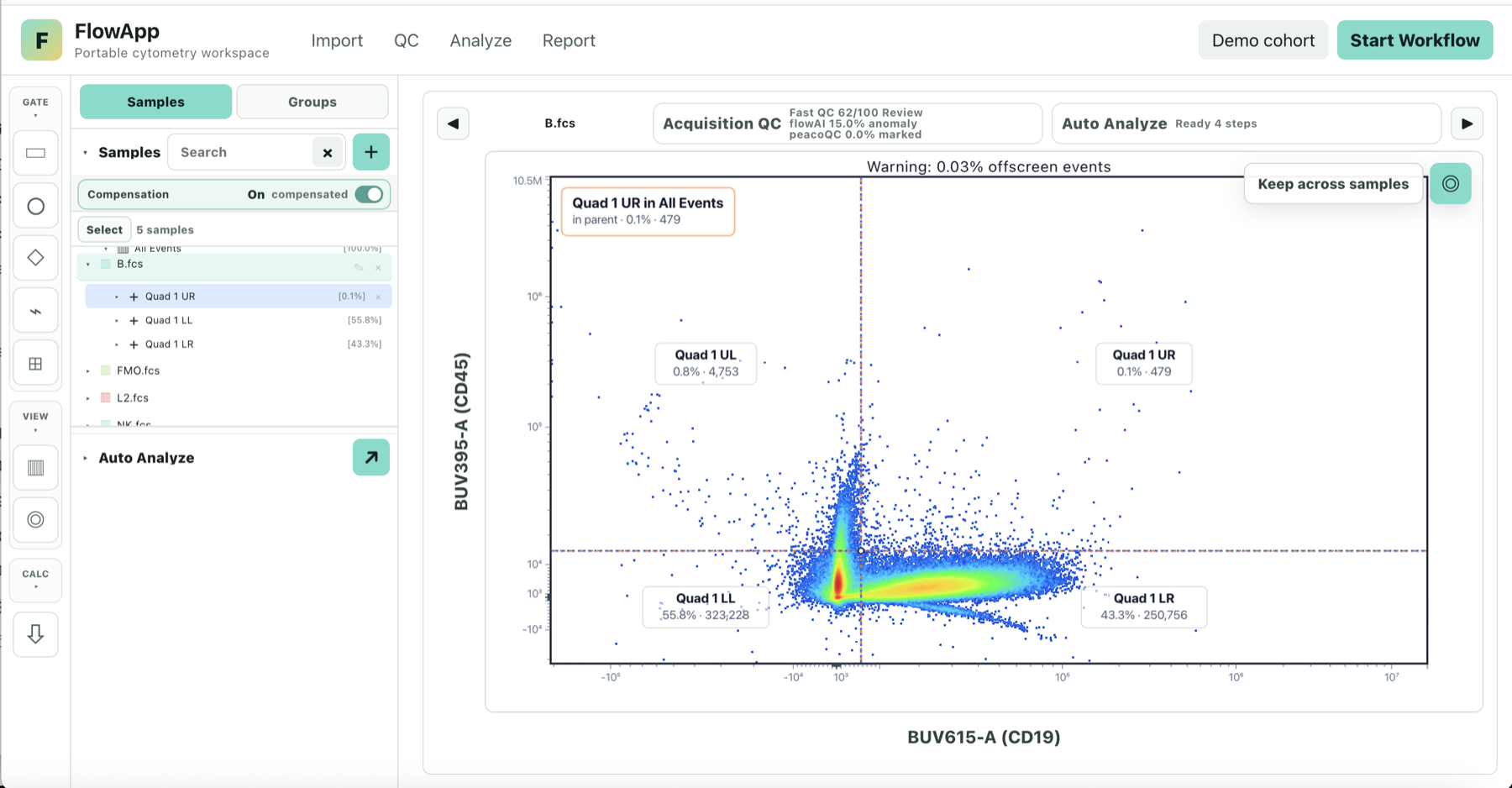
In FlowApp
Open the compensation panel and review the file matrix status before analysis. If the application reports that no matrix was detected, check the source FCS metadata and the instrument's export record before choosing a correction. FlowApp's status is a detection result, not a biological validation of compensation quality.